Ridgewood: looking beneath the skill labels
I have been revisiting what it means to call something a skill in Ridgewood, the adaptive learning app I am building. A label such as 'write a number' can hide several abilities: recognizing a written numeral, connecting it to a quantity, copying its shape, or producing it without a visible example. Someone could succeed at one and struggle with another.
The latest development work focuses on discovering those distinctions from the actual task. The workflow traces the inputs, required outputs, available cues, and concrete steps. It records the smaller abilities and supporting knowledge those steps assume, including foundations outside the named subject. Each proposed distinction needs an observation or practice that would make it useful; the task determines the breakdown.
Before accepting a stopping point, a separate reviewer tries to uncover another useful component. Missing or uncertain assumptions keep the work open. New components are reviewed in turn, and unfinished work remains queued for later exploration. The saved review shows the task assumptions and the reasoning behind a provisional boundary.
The method matters. Handwriting, typing, and selecting an answer can demand different abilities. A component may be necessary for one route without being necessary for every way of completing the task. A provisionally bounded skill can reopen when the representation, method, or task changes.
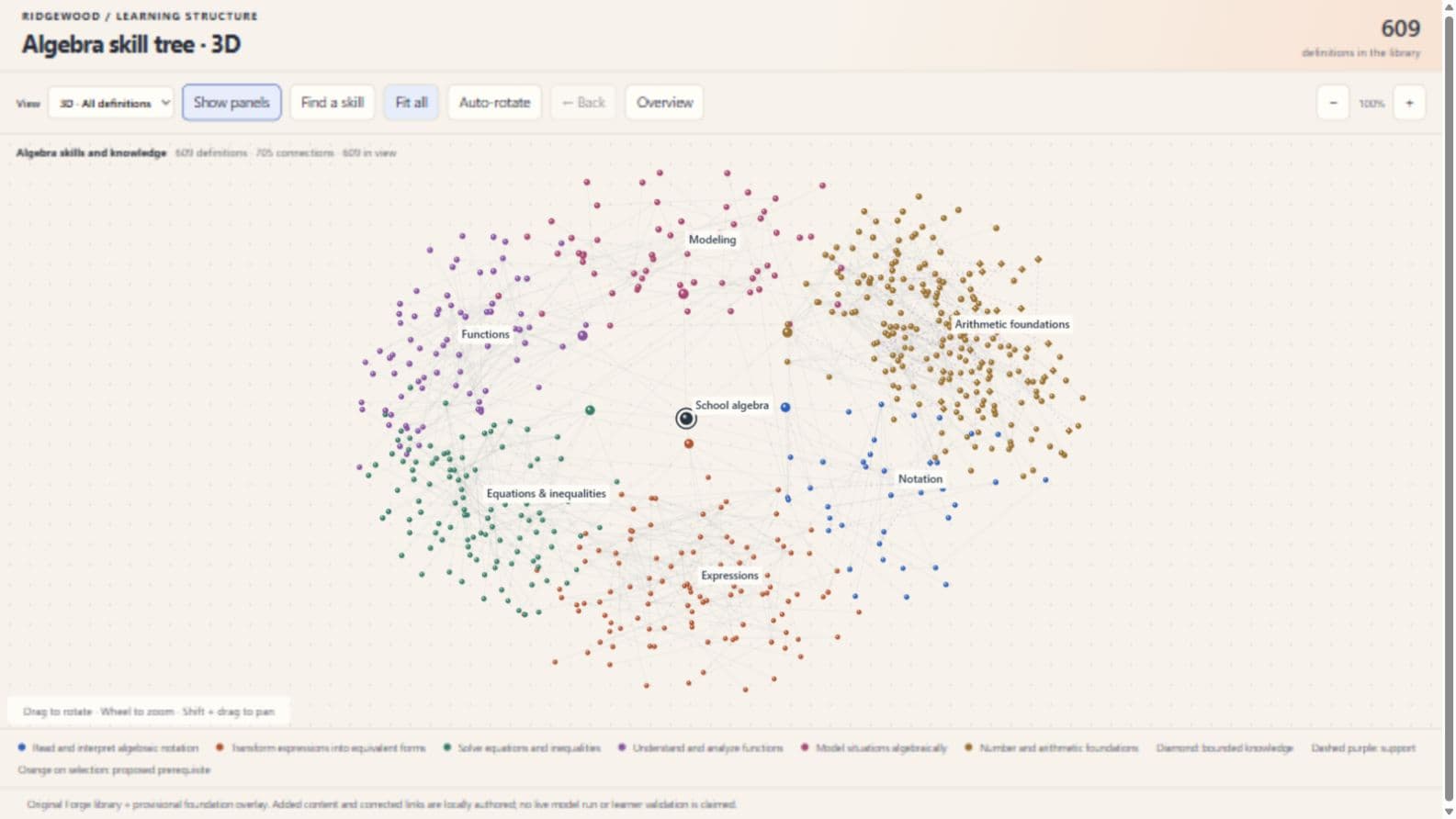
The screenshot shows the existing 609-entry reference library, including a locally authored provisional foundations overlay. The improved discovery workflow has passed deterministic orchestration and regression checks. It has not yet generated a fresh live expansion of this library or been validated with learners. The picture shows the current map, rather than results from that next run.
Adding a definition to the graph does not establish a learner's mastery. Ridgewood still needs observable performance, delayed retrieval, transfer, and less help over time. The aim is to make the assumptions beneath a learning task more inspectable, so the next step can respond to evidence.